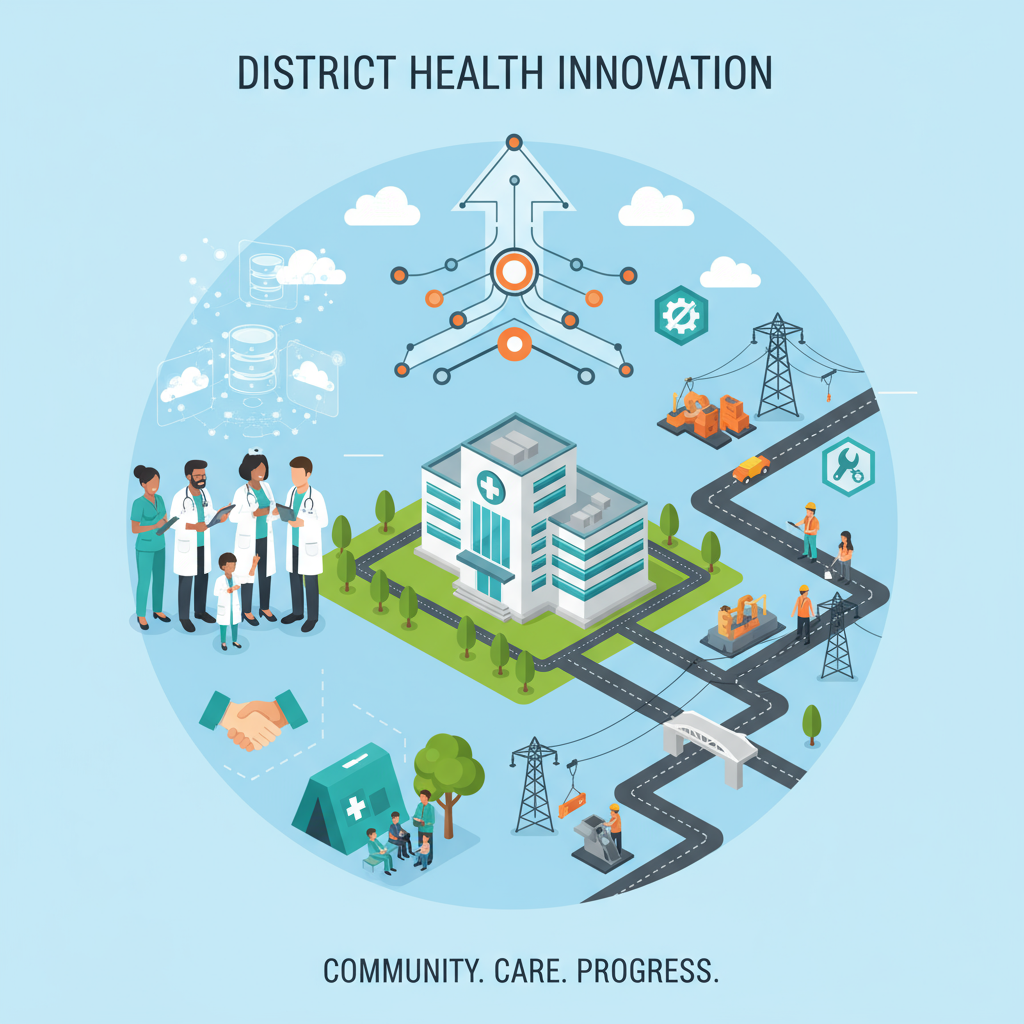

District hospitals, the backbone of secondary care in District level , are currently facing challenges with aging infrastructure and limited resources.
A targeted investment of ₹5 crore per district hospital per year , if applicable across all 806 districts of India, with a ultra focused 5 year plan, accounting only 21000 cr for total 5 year , can fundamentally transform healthcare at the grassroots level.
This focused funding would achieve the following key objectives :
i) Upgrade Infrastructure & Modernize physical facilities and procure essential medical equipment
ii) Enhance Digital Health & Enable the use of health data for disease prediction and improved patient outcomes
iii) Improve Access & Reduce patient referrals to overburdened tertiary centers and better serve rural populations.
iv) Strengthen Staffing by Providing skill development and improve resource allocation for healthcare professional
How will be the District Level Strengthening working ?
So the District Level hospitals will be kept under 5 complexes under one clusters
Cluster One : Quality IPD & IPD Treatment for Surgical, Medical, Gynecological and Pediatric department
Cluster Two : Quality NICU, PICU, HDU, ITU, ICU
Cluster Three : Quality Dedicated ICCU with adjacent Cath Lab. Capacity will be proportional to population density and patient load.
Cluster Four : Dedicated Treatment Centre for Benign as well as Malignant Cancer screening and Tertiary Treatment Centre Offloading Hub
Cluster Five : Dedicated Treatment hub for Trauma – Ortho, Neuro surgical and Vascular
And in all 5 clusters Patient data will be digitized and swiftly inter connected. Patient data obtained in such way will be used for predicting as well as follow up of Chronic illness & Cancer burden
The initial phase of this 5 year plan will be dedicated to foundational improvements and technological integration. T
he first two years will focus on simultaneously upgrading physical infrastructure as well as digitizing health data records.
The improvements of physical facilities includes modernizing wards, improving sanitation, and ensuring reliable power and water supply. Alongside this, we will prioritiz the procurement of essential medical equipment—from basic diagnostic tools like X-ray and ultrasound machines to more advanced life-saving equipments.
Concurrently, a major focus will be on implementing digital health solutions. The goal is to move from paper-based records to a robust, integrated Electronic Health Record (EHR) system.
This shift is not for just convenience; it’s a strategic move to enable the use of health data for disease prediction and improved patient outcomes.
By creating a digital repository of health information, we can analyze trends, identify potential outbreaks, and tailor public health interventions more effectively.
Post 40 yr female irrespective of religion, caste and economic conditions, should be kept under strict surveillance under Breast and all female genital malignancies and Men after age 40 for Diabetes, CVA and Cardiovascular Risks as well as Ophthalmologic Surveillance.
This plan will significantly offload pressure from major healthcare institutions and deliver better, more equitable health outcomes for millions in Rural India. The focus here is to make district hospitals a destination for care, not just a transit point to a larger facility.
As the key objective is to reduce unhelpful patient referrals to overburdened tertiary centers. By empowering district hospitals with better equipment and highly trained staff, we can manage a wider range of medical conditions, thereby alleviating the immense pressure on tertiary-care hospitals
The program if successfully orchestrated, will also directly benefits rural populations by bringing specialized care closer to their homes, reducing travel time, and minimizing financial burden. As they get paid when they work Rural people will loose less unproductive days seeking treatment standing in queues at Tertiary centers and waiting for days to get lab reports done.
I firmly believe that a modest, hyper-focused investment can yield monumental, long-lasting change in District level healthcare landscape.